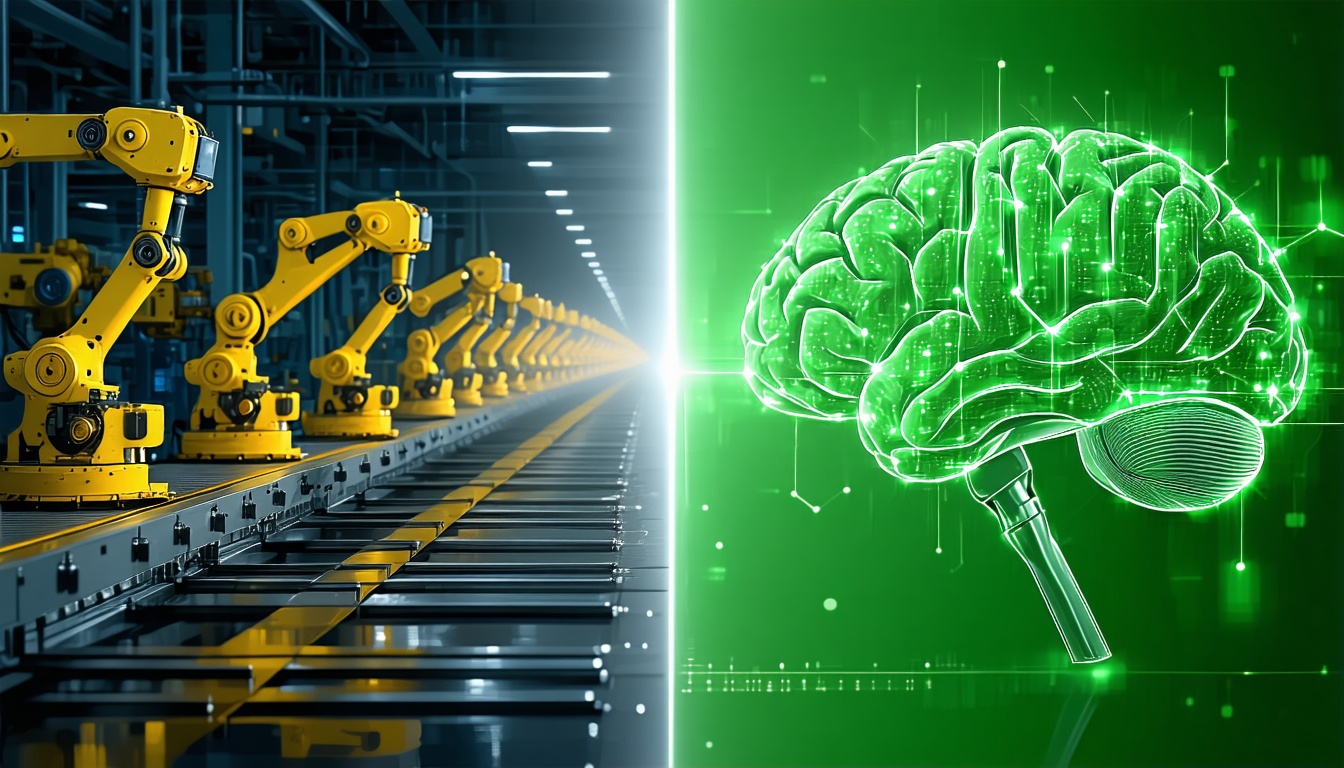
Most teams reach for an LLM-driven agent the moment a task looks "intelligent," then spend three months debugging why their orchestration layer is burning $4,000/day on retries and still missing edge cases that a deterministic Airflow DAG would have caught in milliseconds. The confusion isn't laziness—the boundary between classical automation and AI orchestration is genuinely subtle, and the cost of choosing wrong compounds fast.
What Classical Automation Actually Does Well
Airflow, Temporal, and even Zapier share a common design contract: control flow is known at author time. A DAG in Airflow encodes a finite set of tasks and edges; Temporal workflows encode explicit state machines with durable execution guarantees. When you schedule a nightly ETL that extracts from Postgres, transforms, and loads into Snowflake, the branching logic is a handful of conditionals the engineer already understands completely before the first row moves. Temporal gives you sub-100ms task dispatch latency and replay guarantees out of the box. Airflow can sustain thousands of task instances per day on modest infrastructure.
Crucially, these systems are auditable. Every transition is logged, every retry is deterministic, postmortems are straightforward. If your process is a flowchart you could whiteboard in 20 minutes, classical automation is the right tool. Reaching for an LLM here adds cost, latency, and a 0.5% hallucination baseline to a problem that has zero tolerance for hallucination. We think this is the mistake most teams make—not picking the wrong AI framework, but reaching for AI at all.
What AI Orchestration Actually Does
AI orchestration—whether you're using LangGraph, CrewAI, AutoGen, or a custom loop on top of LlamaIndex—handles a fundamentally different contract: control flow is discovered at runtime based on model output. An agent decides which tool to call next, whether to re-query a Pinecone index for more context, or whether the current answer is sufficient to return. This isn't a fancier DAG. It's a different execution model entirely.
LangGraph represents this as a stateful graph where edges are conditional on LLM-emitted tokens. CrewAI coordinates multiple specialized agents that negotiate task ownership. The value shows up in tasks where the input space is too large or too ambiguous to enumerate branches at author time: document triage across heterogeneous schemas, multi-hop research synthesis, customer support routing that depends on semantic intent rather than keyword matching. The tradeoff is real—you're trading determinism for generality, and paying in latency (p95 easily hits 2–8 seconds for a multi-step agent), cost (GPT-4-class models at 8k context per call add up fast), and observability complexity that most teams severely underestimate going in.
The Structural Differences That Actually Matter
Control Flow Origin
- Classical: Control flow is static or parameterized. Airflow operators, Temporal activities, and Zapier steps are wired by the author before any data arrives.
- AI orchestration: Control flow is emitted by the model. A LangGraph node might return
{"next": "search_tool"}or{"next": "answer"}depending on what the LLM decided, not what the engineer pre-wired.
Context Propagation
Classical systems pass structured payloads between tasks—a JSON blob, a database row ID, a Kafka message offset. AI orchestration systems carry a context window that accumulates conversation history, tool outputs, retrieved chunks from Weaviate or pgvector, and intermediate reasoning. This context is both the system's memory and its primary input. Managing it correctly—deciding what to include, when to truncate, how to compress—is one of the genuinely hard engineering problems we've run into in production AI systems. At 8k tokens per call and $0.01/1k tokens for a capable model, a six-step agent chain costs $0.48 per invocation before you've handled a single retry.
Failure Modes
Temporal and Airflow fail loudly and specifically: a task times out, a dependency fails, a sensor never triggers. You get a stack trace. AI orchestration fails softly and ambiguously: the model produces a plausible-sounding but incorrect tool call, loops unnecessarily, or confidently returns a hallucinated answer. Detection requires completely different tooling—eval harnesses, semantic assertion layers, and OpenTelemetry tracing on every LLM span. A platform team we worked with last quarter had three weeks of on-call pain before they realized their agent was silently looping on a retrieval step rather than escalating. Nothing in their Prometheus dashboards caught it.
A Concrete Decision Heuristic
Before picking a framework, answer three questions about your workload:
- Can you enumerate all branches at design time? If yes, use Temporal or Airflow. If the branch depends on what a document says, you need AI orchestration.
- Is correctness binary or probabilistic? ETL pipelines, payment processing, and compliance checks require deterministic correctness. Summarization, intent classification, and research synthesis tolerate a calibrated error rate.
- What's your latency budget? If p95 must be under 400ms, an LLM call is almost certainly off the critical path. If users accept 3–5 seconds for a complex answer, agent orchestration is viable.
The sharpest hybrid pattern we've seen work in production: use Temporal to own the durable workflow lifecycle—retries, timeouts, state persistence—and invoke AI orchestration as a single activity. Temporal becomes the reliability layer; LangGraph or AutoGen handles the intelligence sub-task. This keeps your audit log clean and your blast radius small when the LLM behaves unexpectedly.
Observability Looks Different for Each
Classical automation integrates cleanly with Prometheus metrics and Grafana dashboards. Task duration, queue depth, error rate—well-understood signals with well-understood tooling. For AI orchestration, you need OpenTelemetry spans capturing token counts, model version, tool call sequences, and latency per hop. A minimal trace for a LangGraph agent should emit something like:
span: agent.run
  span: llm.call model=gpt-4o tokens_in=3412 tokens_out=187 latency_ms=1240
  span: tool.call name=vector_search index=pinecone results=5
  span: llm.call model=gpt-4o tokens_in=6801 tokens_out=94 latency_ms=980
  span: tool.call name=postgres_lookup rows=1
  span: llm.call model=gpt-4o tokens_in=7203 tokens_out=312 latency_ms=1410
total_latency_ms=4180 total_tokens=17709
Without this granularity, you cannot diagnose whether a slow response is a retrieval problem, a prompt engineering problem, or model load. Prometheus alone won't save you here. You need distributed tracing wired into every LLM call and tool invocation, feeding into Grafana or a purpose-built eval platform—and you need it from day one, not bolted on after the first production incident.
Cost and Scale Realities
Teams that migrate rules-based classification pipelines from LLM calls to classical keyword/regex plus lightweight ML models routinely report 40–70% cost reduction with equivalent or better precision on well-defined categories. The inverse is also true: teams that try to encode complex document understanding into Airflow DAGs with brittle regex end up with thousands of hand-maintained rules and 15% error rates. The cost profile inverts depending on problem type, and most teams don't stress-test this assumption before they've already committed to an architecture. At 10k QPS, running every request through a frontier LLM is economically incoherent for tasks that are actually deterministic. Reserve model inference for the irreducibly ambiguous subset of your workload, and use classical orchestration to route, gate, and handle everything else.
Takeaways
- Use Airflow or Temporal when control flow is known at author time and correctness is binary—these systems are faster, cheaper, and far easier to audit.
- Use AI orchestration (LangGraph, CrewAI, AutoGen) only when branching logic depends on runtime model output and your error tolerance is probabilistic, not zero.
- The sharpest hybrid pattern: Temporal owns durable execution and retries; an AI agent handles the intelligence sub-task as a single bounded activity with an explicit token budget.
- Wire OpenTelemetry tracing into every LLM span and tool call from day one—soft failures and cost attribution are invisible without it.
- Migrating deterministic classification from LLM calls to classical pipelines routinely yields 40–70% cost reduction. Reach for AI last, not first.